


International Language House
Preschool offers
a fun and nurturing
environment
for your child!
Language House Bilingual Care

At International Language House Preschool, young children are welcomed into a world where English and Japanese flow naturally side by side.
Our experienced Japanese childcare teachers and international instructors work together in small groups to gently nurture bilingual development. Children explore a rich and varied curriculum filled with songs, dances, games, and art from around the world - while also celebrating traditional Japanese seasonal events. At the same time, we carefully guide them through essential early childhood habits such as toilet training, self-care routines, and table manners, supporting working parents who want both solid upbringing and bilingual education for their children.
Early childhood is when the foundations of communication truly take shape. Through our English–Japanese bilingual environment, we help expand each child’s possibilities and nurture confident young learners who can one day engage with the world as strong, well-rounded individuals.
SCHOOL PHILOSOPHY

Through bilingual education, our goal is to shape the next generation of proud and confident Japanese individuals who live in an increasingly global-minded society by equipping them with the independence and language skills necessary to step fearlessly into the future.
Educational Goal:
Bilingual Early Education
Childcare Goal:
Teamwork and Manners in a Safe Environment
English Language Education Goal:
Vocabulary and Phonics
We provide bilingual education for children from 1 year & 7 months to 3 years old.
Under the supervision and care of both English teachers and Japanese care providers, children will build a bilingual foundation as the base of their education while learning to respect the differences in culture that comes with this approach.
We will introduce the concept of communal living while focusing on developing proper manners and language use between the children and their peers.
1 year & 7 months to 3 years: This age period is an optimal time in a child’s development to introduce and focus on Phonics. At the same time, we will introduce new vocabulary that the child can put together to make simple sentences in their daily life.
STRENGTHS


Why 1 Year and 7 Months?
Bilingual Program
1 year and 7 months is the ideal time to begin training a child’s brain to switch between Japanese and English. At this age, childrens’ linguistic and physical development grow at a remarkable rate where – if we make the most of this opportunity – we can see noticeable results.
Children not only participate in the structured learning program with English teachers but also go through the daily routine with them. They are consistenly exposed to English. Since they hear it on a daily basis, they are able to improve their English-listening ability – something they would not be able to do in a different environment.


Japanese Childcare Reliable Support
Dual Teaching System Featuring English Teachers and Japanese Childcare Providers
In addition to receiving instruction in English from our English teachers, our Japanese providers provide support in Japanese to help the children build foundational daily habits such as toilet training, changing clothes, putting things away, etc. Daily consultation on childcare is available for parents/guardians.
The school is staffed by a qualified English teacher and experienced Japanese providers. We provide family-like childcare in small groups, carefully attending to the childrens’ development so that they can focus on enjoying their time at school.

Learn While Having Fun
We provide opportunities to nurture children’s curiosity by offering fun, developmentally-appropriate activities for preschoolers, such as learning about cultures from around the world, participating in “Show & Tell” sessions where they share their favorite things, and engaging in leadership activities where they take on specific roles.
DAILY SCHEDULE
The classroom is filled with the teacher’s English and children’s laughter. The walls are lined with children’s seasonal artwork. The collaboration between the experienced Japanese providers and English teachers motivates the children and nurtures their strong character. We provide a safe and comfortable childcare environment from the time children arrive at school to the time they are picked up. Here, we introduce a typical day at Language House Preschool.

1. Arrival & Free Play
2. English Lesson
3. Morning Meeting


4. Dance & Craft Time
5. Outdoor Play Activity
6. Lunch Time
“Good morning!” To help children feel at ease when separated from Mom and/or Dad, our teachers greet them with a cheerful welcome. We carefully listen to any updates - including how the child(ren) are feeling that day - and use this information to plan the day’s activities. The children put away their shoes and backpacks on their own, and then enjoy free play until all their friends have arrived.
Let’s start by learning the basics! Using original teaching materials, students will learn everyday concepts such as numbers, colors, and shapes in English. With classes limited to 1–3 students, even children who are new to English can feel at ease in our small classroom environment.
Together, everyone says, “Good Morning!” and greets each other.
Once the greetings are over, a student is chosen at random to be the daily leader. They check today’s weather in English and hand out everyone’s water bottles. This naturally helps them build the confidence to speak English in front of others and develop leadership skills that show consideration for their friends.


At ILH, we use original programs featuring dance and crafts based on monthly themes and Japanese culture.
By combining different approaches, participants will have fun while learning practical English for everyday life.
The children then get ready to play outside with their English teacher and have fun at the playground!
Japanese childcare staff will be on hand to ensure everyone’s safety.
After a busy morning, the children wash up and prepare for lunch time, which starts with a greeting in Japanese: “Now let’s eat. Itadakimasu!” The children learn Japanese manners and also have fun eating together. Even children who usually dislike certain foods want to eat with their friends! We also take measures to ensure any children with allergies are kept safe.
7. Daily Review & English Activity
8. Pick-Up Time (Regular Hours)
9. Nap Time (Extended Hours)


The children say "See You!" to their friends leaving at the regular dismissal time.
When you pick up your child, our teachers will share highlights from the day’s activities - from English class achievements to special moments with friends - giving you a meaningful glimpse into your child’s day at school.
After a day of learning and playing, it’s time for a good rest during “Nap Time.” While your child sleeps, our childcare staff and foreign instructors stay by their side, ensuring their safety through regular breathing checks and other thorough monitoring.
10. Snack Time (Extended Hours)
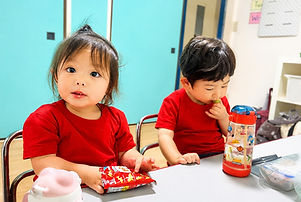
After a restful nap, the children are gently awoken to the call "It's snack time!", and recharge with snacks brought from home.
After snack time, they wait with smiles on their faces for their parents to pick them up.
Q&A

Q: This will be the first time being away from my child. Will we be separated from the beginning? A: One of our nursery school’s basic principles is to separate parents and their child from the beginning. As your child communicates with teachers and friends on his or her own, he or she will develop a sense of independence.
Q: Will childcare be conducted completely in English? I am worried that my child will forget Japanese. A: Childcare at the school is provided in both Japanese and English. The two languages are naturally acquired as the children talk with the English teachers and Japanese providers.
Q: Is school lunch provided? A: In early childhood, during meals it is important to build on the experience of “I can eat it!”. For this reason, we ask that you prepare a lunch box that is tailored to your child’s needs, rather than a uniform school lunch.
Q: What type of menu is best for the lunch box? A: Bite-size portions consisting of mainly of your child’s favorite foods are likely to be more appetizing. Please consult with the provider regarding the amount and ingredients.
Q: What do you do in free play? A: During free play time, children enjoy dancing and singing with English teachers, while becoming familiar with English. With Japanese providers, children engage in Japanese fingerplay and songs.
Q: How can parents receive updates about classroom activities? A: You will be provided with updates about your child through the Communavi App. Please feel free to contact us anytime with any concerns you may have.
Q: Can I change the childcare hours? A: Pick-up times are requested at 1:00 p.m., 3:00 p.m. and 6:00 p.m. to accommodate children’s activities. Please feel free to contact us for extensions due to sudden schedule changes.
Q: Do I have to use childcare 5 days per week? A: We provide childcare starting from a minimum of 2 days per week. Please choose from 2 to 5 days per week.
Q: What time is drop off? What if I am going to be late? A: In order for everyone to enjoy the morning program, we ask that you arrive at the school between 8:00 and 9:00 am. Please contact us if you will be late.
Q: Are there any long vacations, such as summer or winter vacation? A: We will be closed during the Obon and Christmas periods. Please check the schedule for dates.
Q: Can my child be potty-trained during childcare hours? A: Toilet training will be discussed with you while monitoring your child’s progress. Please consult with Japanese providers about when to switch to underwear.
Q: Do you offer outside activities? A: Yes! On sunny days, we take the kids for a stroll to the park nearby or they play in the sandbox. The children absorb English through these experiences outside.
Q: If my child attends ILH Preschool, is there a priority for admission to the ILH Kindergarten? A: Yes! Students who attend ILH Preschool will be given priority for admission to ILH Kindergarten. The preschool prepares students to become familiar with English in preparation for English education in the Kindergarten.

If you have any other questions, please feel free to contact us!


WHY BILINGUAL?

As the environment surrounding Japan undergoes major changes, the level of communication skills required of children in the future will also need to be more advanced than it is today. From a young age, it is imperative to provide children with opportunities to practice differentiating between Japanese and English, comprehending both languages, and using varied communication styles depending on the situation. Infancy (from 1 year and 7 months.) is the best age to start learning about “manners,” “language,” and “life skills”. Language House Preschool provides valuable learning opportunities that cannot be experienced at English cram schools or tutoring schools that children can use as they continue and progress into elementary school.
About International Language House Preschool
Name
Established
Principal
TEL
Address
Director
International Language House Preschool
April 1, 2018
Yoshiko Kurobe
045-947-2202
2-chōme-11-16 Shinoharahigashi
Kohoku Ward, Yokohama, Kanagawa 222-0022
Junko Uranashi